Framework for Cross-Channel Email and SMS Sequences

Cross-channel email and SMS sequences combine the strengths of both channels to improve sales outreach. Emails provide detailed information, while SMS delivers quick, timely nudges. Together, they create personalized workflows that adapt based on user actions, driving higher engagement and conversions.
Key benefits of using email and SMS together:
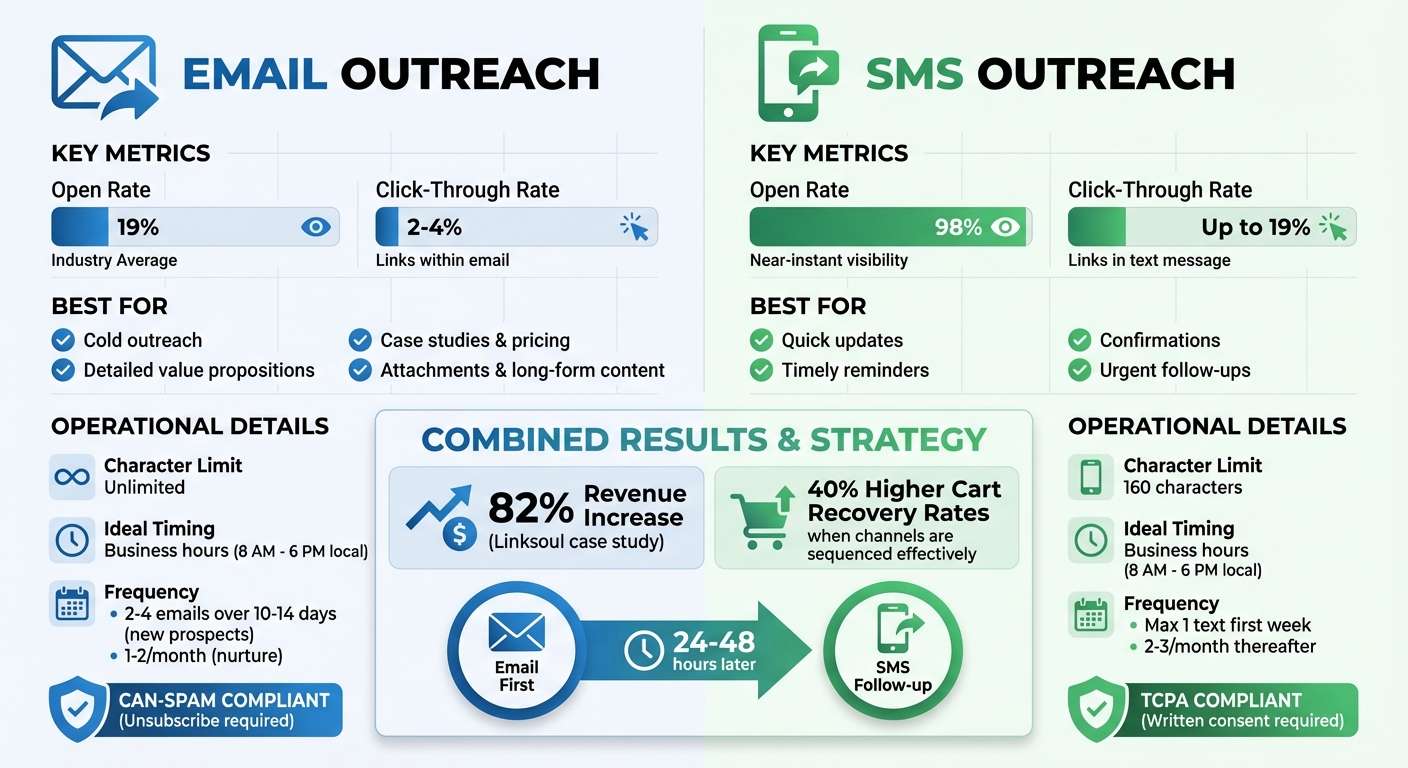
- Higher engagement rates: SMS has a 98% open rate and up to 19% click-through rate, compared to email’s 19% open rate.
- Improved ROI: Combining channels reduces missed opportunities, as seen with Linksoul’s 82% revenue increase after adding SMS to email flows.
- Behavior-driven communication: Tailor messages based on actions like email opens or link clicks.
Challenges to address:
- Compliance risks: Follow TCPA for SMS and CAN-SPAM for email to avoid fines.
- Message fatigue: Avoid overloading users with excessive outreach.
- Channel conflicts: Ensure email and SMS are coordinated to prevent duplication or confusion.
How AI helps: Tools like Salesforge automate message creation, timing, and personalization. Features like Warmforge protect deliverability, while AI SDRs like Agent Frank handle lead research, message drafting, and follow-ups.
Best practices for cross-channel outreach:
- Use email for detailed content (case studies, pricing) and SMS for short, urgent updates (reminders, confirmations).
- Schedule messages during local business hours and limit frequency to avoid opt-outs.
- Build conditional logic into campaigns, adapting based on user responses.
Email vs SMS Performance Metrics and Best Use Cases
Core Principles of Email and SMS Integration
Navigating the challenges of channel conflict and compliance requires a thoughtful approach. By establishing clear rules for how email and SMS should work together, you can avoid confusion, stay compliant, and make the most of your budget. The secret lies in playing to the strengths of each channel within a unified strategy.
How to Use Each Channel
Email and SMS each have distinct roles in outbound sales. Email is your go-to for cold outreach, presenting detailed value propositions, sharing case studies, discussing pricing in USD, and sending attachments. It’s the channel where you can explain and persuade.
SMS, on the other hand, shines when brevity is key. Use it for quick updates, timely reminders, or confirmations - all within 160 characters. If a prospect tends to respond more through SMS than email, prioritize texts for reminders while reserving email for more detailed communication. Tools like Salesforge can streamline this process by creating tailored messages for both channels. For example, it can generate personalized email content and automatically craft concise, mobile-friendly SMS versions, ensuring your messaging stays efficient and effective.
U.S. Compliance Rules for Email and SMS
Staying compliant with U.S. regulations is crucial - not just for protecting your sender reputation but also to avoid hefty fines. For email, the CAN-SPAM Act requires:
- Clear identification of messages as advertisements (when applicable)
- Accurate "From" and subject line details
- A valid physical postal address
- An easy-to-find unsubscribe option that’s honored within 10 business days
Avoid misleading headers or deceptive content to stay on the right side of the law.
For SMS, the rules are even stricter. The Telephone Consumer Protection Act (TCPA) mandates that marketers secure prior express written consent before sending marketing texts. This typically involves using web forms with clear language and unchecked boxes to ensure users understand what they’re agreeing to. Every SMS must clearly identify the sender and include opt-out instructions, such as “Reply STOP to opt out,” which must be processed immediately.
Additionally, keep detailed records of consent, including timestamps, IP addresses, and sources. Synchronize suppression lists across all channels to ensure that if someone opts out via email or SMS, they’re removed from all related campaigns. Tools like Salesforge can help manage these lists seamlessly across multiple channels, reducing the risk of accidental violations.
Managing Message Frequency and Timing
The timing and frequency of your messages can make or break your cross-channel communication strategy. For email, a typical B2B approach involves sending 2–4 emails over 10–14 days for new prospects, followed by 1–2 nurture emails per month if there’s no response. For SMS, start cautiously - send no more than one text in the first week and limit to 2–3 texts per month, ensuring that engagement levels and explicit consent justify further outreach. Avoid bombarding cold leads with daily SMS, as it can feel intrusive and lead to higher opt-out rates.
Timing also matters. Schedule messages during local business hours (8:00 AM–6:00 PM) and avoid sending them at odd hours. A smart tactic is to stagger your outreach - send an email first and, if there’s no response, follow up with an SMS reminder 24–48 hours later. Use conditional logic to manage daily touchpoints and pause outreach for 48–72 hours after receiving a reply.
AI tools like Salesforge’s Agent Frank can take this a step further by automatically determining the best channel for follow-ups based on real-time engagement data. By applying these principles, you can create a strong cross-channel framework that delivers results without overwhelming your audience.
How to Build a Cross-Channel Framework
Now that we've covered the advantages and principles of integration, it's time to establish a framework that can be applied across campaigns. The aim is to create a structure that aligns your outreach with real sales goals while respecting how prospects interact with your content. This involves defining success, setting clear channel rules, and incorporating flexible logic.
Map Your Goals and Customer Journey
Start by outlining your main goals and linking them to specific stages of your customer journey. For example, during cold prospecting, you might aim for a 20% reply rate. At this stage, email is a great way to introduce your value proposition and build awareness. If an email isn’t opened within 48 hours, follow up with a short SMS like, "Quick question on your Q4 goals? Reply YES."
Once your objectives are clear, align the stages of the customer journey with the most effective channels. For instance, in a re-engagement campaign targeting past leads, you might set a goal of securing 15% demo bookings. Begin with a personalized email that references prior conversations, then escalate to SMS if no response is received. A message like, "Saw you opened our last email - demo available Thursday?" can work well. Studies show that when goals are tied to journey stages and channels are sequenced effectively, cart recovery rates can increase by 40%. Break down each stage - awareness, consideration, and decision - and assign the right channel mix based on the urgency and complexity of your message.
Set Rules for Each Channel
Develop a simple decision framework to guide your channel choices. Picture a decision matrix with urgency on one axis and message complexity on the other. For low-urgency, low-complexity scenarios, email is perfect for detailed nurturing. When urgency is high but the message is straightforward, SMS shines - think along the lines of, "Flash sale ends tonight!" For cases where both urgency and complexity are high, use a combination: send a detailed email with full context, then follow up with an SMS reminder 24–48 hours later if there’s no engagement.
Pay attention to how prospects prefer to engage. For example, if someone consistently responds to SMS, prioritize texts for reminders but save emails for more detailed updates. Tools like Salesforge can help automate personalized content for both email and SMS, ensuring your communication stays relevant.
Create Sequence Logic and Conditional Paths
To make your cross-channel outreach effective, use branching logic that adapts to how contacts interact with your messages. Start with a trigger event - such as a new lead, demo booking, or trial sign-up - and design multi-step sequences with conditional splits. For instance, send an initial email on Day 1 introducing your value proposition. If the recipient opens the email but doesn’t click by Day 4, follow up with another email featuring a case study. If there’s still no engagement by Day 7, send a short SMS like, "15-min demo slot open?" If the prospect replies at any stage, move them into a demo booking flow and exit the original sequence.
Behavioral triggers allow for personalized follow-ups. For example, if someone clicks a link but doesn’t convert, you could send a targeted offer via email, followed by a time-sensitive SMS reminder. Be sure to implement suppression rules to avoid over-messaging - if someone books a meeting or makes a purchase, stop all further sales outreach. This not only keeps your communications compliant but also prevents message fatigue, maximizing your ROI. AI tools like Salesforge's Agent Frank can handle these conditional paths, analyzing engagement data in real time to determine the best follow-up channel. This dynamic approach can boost conversions by 40% compared to static, one-size-fits-all sequences.
Using AI and Tools for Cross-Channel Outreach
A well-structured tech stack can turn manual outreach into scalable, automated campaigns. By leveraging AI, businesses can fine-tune their messaging and streamline personalization. AI platforms take on tasks like message creation and orchestration, freeing up sales teams to focus on meaningful conversations. The key is to choose tools that centralize data, automate processes intelligently, and integrate smoothly with existing systems. This approach ensures messaging is not just automated but also tailored and impactful.
Automate Personalization at Scale
AI tools can analyze intent signals, engagement metrics, firmographic data, and behavioral triggers to create customized email and SMS messages for each prospect. For emails, AI generates detailed messages that include problem statements, value propositions, case studies, and calls to action (CTAs), all tailored to the recipient. SMS messages, on the other hand, are concise (under 160 characters), with a single clear CTA that complements - rather than repeats - the email content.
Take Salesforge as an example. This platform uses AI to research leads (their website, LinkedIn profile, and tech stack) and craft hyper-personalized email subject lines, body content, and first lines in multiple languages. It can break messages into modular content blocks - like introductions, pain points, offers, proof, and CTAs - that can be shortened and repurposed for SMS. For instance, the most compelling proof and CTA from an email can be distilled into a one- or two-sentence SMS. Salesforge also ensures deliverability by validating emails and warming up inboxes through its Warmforge feature. Additionally, it integrates with SMS providers to trigger follow-ups, like sending a text if an email remains unopened or a link is clicked without a meeting being booked.
The platform uses a single AI engine to maintain a consistent "message spine", which includes the target persona, core pain point, primary offer, credibility asset, and CTA. This spine supports both a detailed email version and a shorter SMS variant. To avoid redundancy, you can set rules - for instance, if a prospect clicks a link in the email, the SMS can serve as a gentle nudge or confirmation ("Still open to chatting about X this week?") rather than repeating the original pitch. By storing these rules as templates, you can apply them to new outreach sequences, with AI filling in personalized details like company names, roles, or recent events.
Connect Your Tools for Better Execution
For cross-channel outreach in the U.S., an ideal tech stack includes:
- A CRM (like Salesforce or HubSpot) to manage accounts, contacts, and revenue data.
- A cold email platform such as Salesforge for AI-driven sequencing, inbox warm-up, validation, and multi-mailbox management.
- An SMS provider or messaging API, integrated with the email platform either natively or through middleware like Zapier or Make.
- Data enrichment tools to keep lead information accurate and up-to-date.
Bidirectional syncing is crucial. Events like email opens, SMS replies, or bounces should be logged in the CRM, giving sales reps a complete view of each prospect's journey and ensuring no one gets contacted twice unnecessarily.
When Salesforge is at the center of this setup, it orchestrates message timing and delivery. Meanwhile, the CRM tracks pipeline and revenue, and the SMS provider ensures compliance and proper routing. Salesforge integrates seamlessly with CRMs, lead generation tools, and workflow automation platforms via Zapier, webhooks, or APIs.
Unified platforms can lead to impressive results. For instance, apparel brand Linksoul added SMS to its automated email flows using Klaviyo, achieving an 82% year-over-year increase in flow revenue. By consolidating email and SMS into one platform, they optimized customer interactions across channels, avoiding the fragmented experience often caused by separate tools. AI-powered sales development representatives (SDRs) further enhance this automation loop.
Use AI SDRs for Complete Automation
AI Sales Development Representatives, like Salesforge's Agent Frank, take automation to the next level by handling tasks such as:
- Sourcing and enriching leads
- Segmenting audiences by persona and intent
- Building multi-step email and SMS sequences
- Writing personalized messages
- Scheduling sends across multiple mailboxes
- Responding to simple inquiries ("send more info," "not the right person")
- Booking meetings directly into sales reps’ calendars
Instead of manually researching accounts or crafting messages, SDRs oversee tools like Agent Frank, approving strategies (like Ideal Customer Profiles or compliance rules) and stepping in only for high-priority conversations or complex objections. This allows teams to focus on strategic tasks like call preparation and deal planning, all while maintaining high outbound volume.
Agent Frank operates like a top-performing sales rep, trained on a proprietary data lake with advanced AI and machine learning capabilities. It engages prospects via email and LinkedIn, ensuring interactions feel natural and human. For example, VAI Consulting booked 3 calls in a single week using Agent Frank, while UniteSync achieved an 85.26% positive reply rate and a $2.86 Customer Acquisition Cost (CAC). UniteSync's CEO, Carlos Palop, shared:
"Our CAC is currently $2.86, and we expect it to decrease even further. We're currently onboarding 4 to 5 new music creators every day. We truly believe in what you're building at Salesforge. Your guidance on how to scale and reach the right customers has been a game changer for us. Tying your strategy of setting up domains + inboxes + warming up + daily limits with our royalty audit lead magnet has allowed us to grow efficiently, bringing in strong results without excessive effort. It's made a real difference."
To ensure compliance and protect deliverability, enforce rules like:
- Including opt-out options in SMS and email (per TCPA and CAN-SPAM guidelines for U.S. audiences)
- Setting daily and hourly volume caps for emails and SMS
- Scheduling messages during appropriate hours based on the recipient’s local time zone
- Using approved tone guidelines and example messages to maintain brand voice
Tools like Salesforge’s Warmforge help maintain deliverability by warming up inboxes, rotating mailboxes, and validating emails before sending. Avoid spammy practices, such as overloading messages with images or links, to ensure outreach remains effective and professional.
How to Optimize Cross-Channel Campaigns
Setting up your initial framework is just the starting point. The real magic happens when you continuously monitor, test, and refine your approach. This process creates a feedback loop where data drives smarter decisions, AI identifies winning patterns, and each iteration of your campaigns outperforms the last. It all begins with tracking metrics across your channels.
Track Performance Across Channels
Start by identifying the key metrics that matter for your outreach efforts. For cold email and SMS campaigns, focus on metrics like reply rate (the percentage of responses), positive reply rate (replies that show interest), meeting rate (responses that lead to booked calls), and customer acquisition cost (CAC). Track these metrics separately by channel. For example, SMS often boasts higher open rates (up to 98%) and click-through rates (up to 19%) compared to email's 19% open rate and 2–4% click-through rate. While email is great for delivering detailed messages, SMS works best for quick nudges and time-sensitive reminders.
Cross-channel engagement metrics highlight how your channels complement each other. For instance, track how many prospects open an email but click through via a follow-up SMS, or the other way around. Platforms that consolidate email and SMS data into unified customer profiles make it easier to track the full journey without double-counting conversions. Apparel brand Linksoul, for example, added SMS to their email flows and saw a boost in flow revenue. They targeted "high-value SMS responders" (customers who spent $200+ via SMS in the last 180 days) with weekly SMS campaigns, reducing unnecessary touches on email-only buyers.
Don’t stop at engagement metrics - keep an eye on deliverability and inbox placement as well. Monitoring your domain reputation, warming up inboxes using tools like Warmforge, and validating emails before sending can significantly improve results. By continuously optimizing these areas, you can lower your CAC while increasing positive reply rates.
Also, watch out for unsubscribe rates and spam complaints. If a specific email or SMS triggers a spike in opt-outs, it’s time to rethink or remove that touchpoint. Staying compliant with U.S. regulations like CAN-SPAM for email and TCPA for SMS isn’t just about following the law - it also protects your deliverability and ensures your campaigns run smoothly.
Test Different Approaches
One of the fastest ways to improve your campaigns is through systematic testing. Use A/B tests to compare variables such as:
- Channel order: Should you send an email first, followed by an SMS, or vice versa?
- Timing: Does sending an SMS 2 days after an unopened email perform better than sending it immediately after a link is clicked?
- Messaging style: Compare a detailed email paired with a short SMS follow-up versus a brief email followed by a more value-packed SMS.
Experiment with both the order and content of your messages. For example, some brands find that "launch" and "last chance" messages drive about 80% of their revenue, while mid-sequence reminders contribute around 20%. Use these insights to focus on high-impact messages and cut out underperforming ones.
Retargeting based on user actions is another powerful strategy. If a prospect opens your email but doesn’t reply, send a follow-up SMS. If they click a link in your SMS but don’t book a meeting, follow up with a personalized email offering more details. VAI Consulting used Salesforge’s AI SDR, Agent Frank, to automate these multi-touch follow-ups and successfully booked three calls in a single week. These testing insights can then guide data-driven improvements to your overall strategy.
Use Data to Improve Your Sequences
Leverage the data you’ve gathered from testing and performance tracking to fine-tune your sequences. Analyze which email-SMS combinations lead to the most conversions. For instance, if prospects who visit your website and then receive an email followed by an SMS 24 hours later convert at twice the rate of email-only contacts, allocate more resources to that flow. Segment your audience based on behavior - like "email browsers who prefer to buy via SMS" - and customize your sequences accordingly. Be sure to exclude follow-ups for prospects who’ve already converted to avoid over-messaging.
AI tools can take this a step further by generating and testing variations, identifying the best send times, and spotting winning patterns. For example, Salesforge’s AI can craft highly personalized email subject lines and body content, then distill the key points into a concise SMS. Agent Frank automates the entire process - from lead generation to booking meetings - while continuously learning from engagement data to improve personalization at scale. AKOOL used Salesforge to reach over 214,000 prospects with a positive reply rate exceeding 16%, proving that AI-driven optimization can scale outreach without compromising quality.
Insights from one channel can even improve others. Net New Solutions, for example, used data from their email campaigns to refine their calling strategy. CEO Tim Savage shared:
"Once I had it set up and was sending, I saw excellent open rates with high deliverability. But when I saw the high number of opened emails, I was able to hone in on my calling campaigns even further."
This shows how a single channel’s performance can inform and enhance your entire outreach strategy. By treating optimization as a continuous process - track, test, refine, and repeat - you can steadily improve reply rates, meeting rates, and ROI while respecting your prospects’ time and staying compliant with regulations.
Conclusion: Key Takeaways for Cross-Channel Sequences
To make the most of cross-channel strategies, seamless data flow between platforms is essential. Each channel plays a distinct role: email is ideal for sharing detailed content like offers or case studies, while SMS is perfect for quick, timely nudges. For instance, apparel brand Linksoul introduced SMS into their email workflows and achieved an 82% year-over-year increase in flow revenue by targeting high-value SMS responders strategically. The key is to let behavior guide your next step: if a prospect opens your email but doesn’t respond, follow up with a concise SMS within 24–48 hours. If they engage with the SMS by clicking a link, send a detailed email outlining the next steps.
Using a unified platform is critical for integrating data and ensuring smooth execution. Such platforms allow you to create conditional sequences, monitor attribution across channels, and maintain sender reputation. Tools like Warmforge help safeguard email deliverability by validating addresses and tracking bounce and complaint rates. Additionally, for U.S.-based outreach, compliance with CAN-SPAM for email and TCPA for SMS is non-negotiable. Clear opt-outs, explicit consent, and regular list hygiene are not only legal requirements but also essential for building trust and sustaining campaigns.
Scaling these strategies becomes much easier with AI. AI-powered tools like Salesforge can automate tasks such as personalization, warm-ups, and multi-channel coordination, allowing your team to focus on closing deals. For example, Agent Frank, an AI SDR, handles prospecting, message drafting, follow-ups, and meeting bookings from start to finish. Companies like VAI Consulting used Agent Frank to book three calls in just one week, while AKOOL reached over 214,000 prospects with a 16%+ positive reply rate.
The difference between successful programs and those that stagnate lies in continuous optimization. Track metrics like reply rates, meeting bookings, and revenue by channel and sequence. Experiment with the order of channels (e.g., starting with email versus SMS), timing (immediate follow-ups versus a 24-hour delay), and message combinations to see what resonates. Net New Solutions, for instance, used email open data to refine their calling strategy, showing how insights from one channel can enhance overall performance. Incorporate these learnings into your framework to drive consistent growth.
Cross-channel sequencing isn’t just a nice-to-have - it’s a proven way to generate revenue. When email and SMS work together, supported by data and AI, they deliver higher reply rates, more meetings, and a stronger pipeline. Start with a solid framework, let AI handle the repetitive tasks, and keep refining your approach. The teams that succeed treat optimization as an ongoing effort, not a one-time task.
FAQs
How can businesses stay compliant when using email and SMS for outreach?
To ensure compliance with email and SMS outreach regulations in the U.S., businesses need to adhere to key laws like the CAN-SPAM Act for email and the TCPA for SMS. This involves securing clear consent before sending messages, providing straightforward opt-out options, and promptly respecting recipient preferences.
Platforms like Salesforge can make this process easier by automating consent tracking and managing opt-outs for both email and SMS. It's equally crucial to keep accurate records of permissions and regularly review your policies to stay aligned with legal requirements. Following these practices not only minimizes legal risks but also safeguards your sender reputation.
How does AI improve cross-channel communication strategies?
AI brings a new level of efficiency to cross-channel communication by making outreach both personalized and scalable while simplifying intricate workflows. With AI-powered tools, businesses can create customized messages, improve email deliverability, and automate tasks like lead generation, follow-ups, and coordinating multi-channel campaigns.
Take email and SMS outreach, for instance. AI can synchronize these channels to maintain consistent messaging, which helps boost engagement rates. It also equips sales teams with smarter reply management, enabling quicker responses and reducing the risk of missed opportunities or being marked as spam. These features position AI as a game-changer for crafting communication strategies that are both effective and scalable.
How can businesses manage message frequency to avoid overwhelming their audience?
To keep your audience engaged without overwhelming them, businesses should adopt a balanced approach that spreads communication across multiple platforms, such as email and SMS. Leveraging AI-driven tools can make this process smoother by tracking user engagement and adjusting follow-up timing based on individual behavior. This ensures your messages are not only timely but also relevant.
Using advanced tools with features like email warm-up and deliverability monitoring helps maintain a solid sender reputation, keeping your messages out of spam folders. Additionally, focusing on targeted and personalized communication minimizes the risk of audience fatigue while boosting overall engagement.